
The Dodge Paddle Shifter Upgrade Explained
What a paddle swap changes on an automatic Challenger, Charger or Durango, how the mount behind the rim decides the fit, and what to test before the drive home.
Read More →Guide · 10/7/2026
What a heated steering wheel retrofit involves on a Dodge: the element, the feed, the control button, the coding, and how to confirm your car suits it.
A Dodge Challenger with heated seats and no heated wheel is a common combination, and owners notice it every winter. The cabin takes a while to warm, and the rim stays cold long after the vents have caught up. A Dodge heated steering wheel retrofit solves that, but it is more involved than swapping a rim. The guide below sets out what the work involves and where the honest limits sit.
Each Dodge heated steering wheel retrofit starts with the car rather than the wheel. Three parts have to come together. The rim needs a heating element built into it. The car needs a supply able to feed that element. The driver needs a control to switch it on. Leave any one of the three out and the retrofit does not work.
| Stage | What it involves | Confirmed by |
|---|---|---|
| Element | Heating mat built into the rim beneath the leather | Rim specification at order |
| Supply | Feed taken from a circuit rated for the load | Wiring check on the car |
| Control | Button or a factory switch position for the heater | Button frame photograph |
| Coding | Control unit told that a heated wheel is now fitted | Diagnostic check after fitting |
A heated rim will fit most LX and LC platform cars, because the wiring and the control modules were shared across the range. Challenger and Charger are realistic candidates, and the Durango is worth asking about.
We will check your chassis code before you buy anything. That takes a few minutes and avoids a wasted purchase. Two conditions rule a car out. A steering column that cannot carry the extra feed safely is one. A button frame with nowhere to put a control is the other, and that one can sometimes be solved with a discrete switch nearby.
The mat sits between the rim core and the leather, and it warms the outer surface rather than the whole wheel. The rim therefore feels warm within a couple of minutes rather than instantly. The element draws a modest current, but the circuit still has to be rated for it.
In practice the warmest area is the grip section, because that is where the mat is concentrated. Coverage varies between elements. A full-rim mat warms all the way round, which is what most owners expect. A partial mat covers the grip areas only and leaves the top and bottom cooler. Confirm which one you are getting before ordering.
The feed is normally taken from an existing circuit inside the column, following the routing Dodge uses on cars built with the option. The control is the part that varies. Some button frames carry a spare position that can take a heater button, and others do not.
Where no factory position exists, a discrete switch can be fitted nearby. It works, but it never looks quite original. Owners who care about that usually prefer to wait for a frame that carries the correct button. Ask us for the switch travel measurement if you are comparing parts yourself. It is the single number that predicts whether a button will feel crisp.
Winter is the obvious reason. For cold starts, a Dodge heated steering wheel retrofit is the change owners notice most. These are big cabins, and the rim is the last surface to warm up. A driver who parks outside and starts the car on a frosty morning feels that every day for four months.
There is a second reason that comes up often. A used Challenger may have almost every option except the heated wheel, and retrofitting costs far less than changing cars. The retrofit then becomes the missing piece rather than an upgrade.
Retrofits begin with the car rather than the wheel. We need the chassis number, the full options list, a photograph of the current wheel, and one of its rear with the airbag out. A Dodge heated steering wheel retrofit cannot be quoted properly without those four items.
A photograph of the fuse box is also useful, because it shows what the car can already support. The photographs show us the spoke profile, the button frame and the plug type. They also reveal whether a heater button position exists. If an image is unclear we will ask again rather than commit to a specification.
Every retrofit has to leave the existing switches working. The factory frame and harness stay in service.
| Function | Typical outcome |
|---|---|
| Airbag | Original module normally reused; cover built to suit it |
| Multifunction buttons | Retained when the original button frame is reused |
| Paddle shifters | Retained on automatic cars; manual cars have no paddles |
| Heated rim | Added by this retrofit, subject to the wiring check |
| Uconnect voice buttons | Retained where the original frame carries them |
Gearbox matters here as it does elsewhere. A manual Challenger has no paddles to retain, so the retrofit concentrates on the heater and the existing buttons.
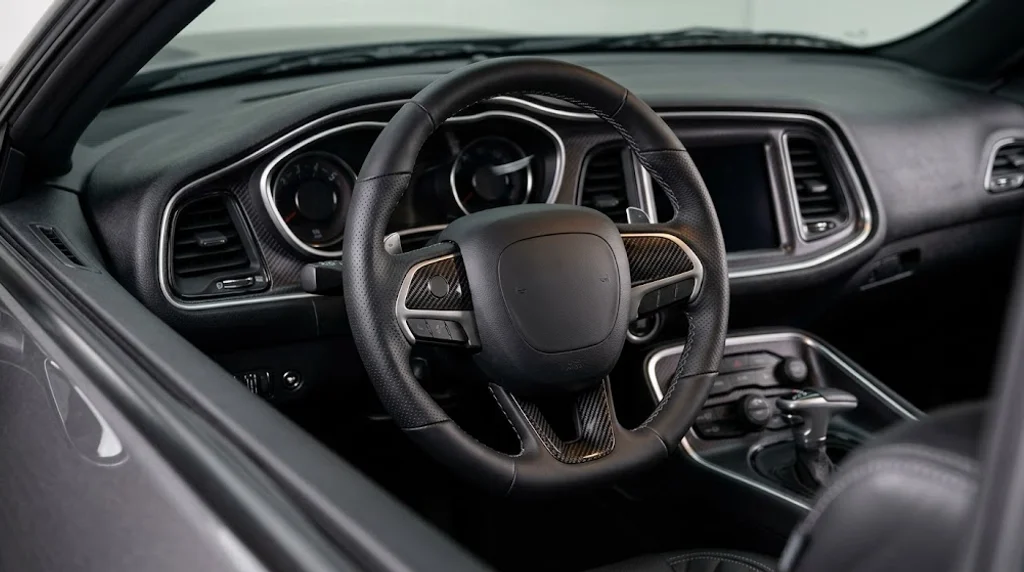
A retrofit normally rebuilds the wheel already in your car, because the frame and electronics have to match. We strip the rim, fit the heating mat, recover it in new leather and reassemble it on your original core.
A second-hand heated wheel from another car is a different route. Keep the original paddles and buttons boxed with the factory wheel, so a return to standard takes an afternoon. It only works if the button frame and connector match, and that is where most purchases of this kind go wrong. Let us see the details before you buy one.
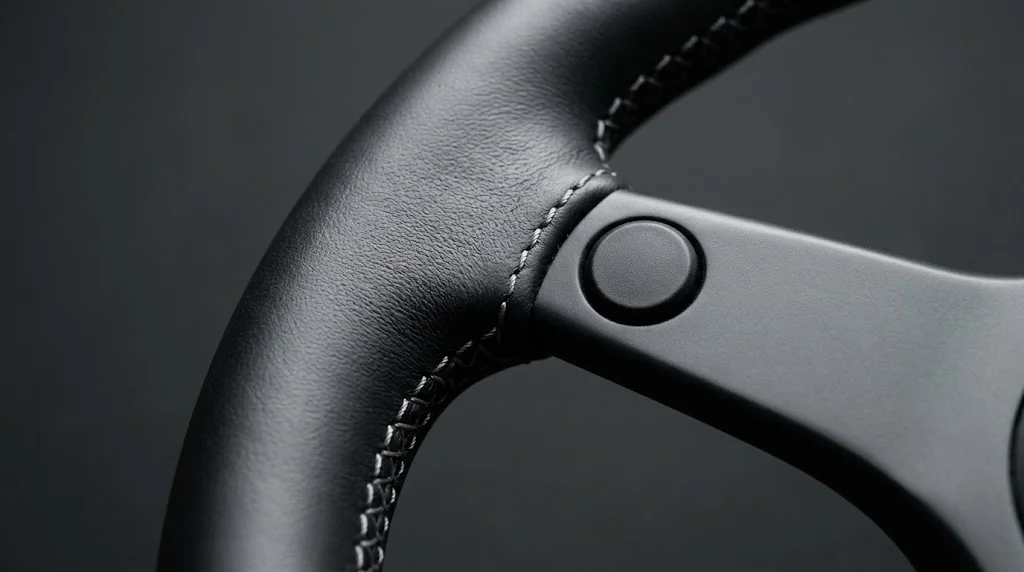
The job involves an airbag and live wiring. Give it to someone qualified. Isolate the battery and let the car sleep fully before touching anything. Follow Dodge procedure for your chassis rather than a general guide from the internet. Set the module on something soft, and tighten the centre fastener to the figure in the workshop manual. Nothing else should substitute for that number.
Once it is together, drive a short distance and confirm the rim is centred. Test every button, the heater, any paddles and the horn. If the dash keeps a warning lit, get the car scanned.
Warranty concerns follow any electrical change. An aftermarket steering wheel does not automatically void a vehicle warranty under U.S. federal warranty law, but warranty coverage can still depend on whether the modification caused the specific failure being claimed.
A Dodge heated steering wheel retrofit often does need coding, and it is worth saying that plainly. It changes the electrical picture, not just the trim. A heating element is being added to a car that never had one. The control unit usually has to be told that a heated wheel is now fitted. Without that, the button may do nothing at all.
A straightforward retrim is different, because it reuses the original module and often needs no coding whatever. Tell us which of the two you are doing. Send the chassis number with images of both electronic units and we will say what the car is likely to need.
Retrofit failures come from three causes. A heating mat intended for a different rim shape fits badly and warms unevenly. An under-rated feed trips a fuse or throws a fault. A button frame with no home for the control leaves a switch that looks added.
A fourth cause is worth knowing about. Some second-hand heated wheels come from cars with a different button set, and the connector will not mate. Checking the part number before purchase avoids the whole problem. None of these four is common, but every one of them is avoidable with a photograph and a part number.
Most LX and LC cars can. We check the wiring and the button frame before quoting, because both have to suit.
A minute or two for noticeable warmth, and around five minutes to reach full temperature. It depends on how cold the morning is.
Not while the engine is running. It draws a modest current, and the feed comes from a circuit rated for it.
On most cars yes, provided the heater is switched on before the car is locked. Behaviour varies between builds, so confirm it after fitting.
Usually yes, because a function is being added. A retrim that reuses the original module often needs none.
Yes, for a retrofit. The frame and electronics must match your car, so we rebuild the wheel you already have.
Workshop time is about ten to fifteen working days, plus fifteen to twenty for shipping. The full cycle takes twenty-five to thirty-five days on average.
Rims are cut, stitched and assembled in our own Guangzhou workshop. Thirteen or more years of design and production experience sit behind the catalogue patterns, and nothing starts before an order arrives. Material, stitch and element coverage are your decisions; each one is checked against your car before the first cut. Every order ships tracked worldwide with a three-year warranty and thirty days for returns via an RMA request.
Our flat bottom versus round guide covers the shape decision, and most of the finishes described here appear in it too. The full range sits in the shop, and the Dodge pages are Dodge fitment and the Challenger listing.
Tell us which car you have and whether it currently has a heated wheel, then add the chassis number and the options list. We will reply with a confirmed build and a date before we begin your Dodge heated steering wheel retrofit. Two catalogue entries cover the rims we build for these cars. The first is the gloss carbon wheel for the Challenger. The second is the matte carbon wheel for the SRT range.
Background reading is on hand if you want it. The installation guide steps through the battery and airbag sequence, and the FAQ collects the questions we hear most. Fitment and shipping questions can be sent through the inquiry form or the contact page. Timings appear in the shipping policy, and returns are handled under the return and refund policy. For the American position on warranty law see the Magnuson-Moss Warranty Act (15 U.S.C. §2304), and for air bag safety see NHTSA.
What a paddle swap changes on an automatic Challenger, Charger or Durango, how the mount behind the rim decides the fit, and what to test before the drive home.
Read More →How to clean carbon fiber and Alcantara on a Dodge steering wheel: a ten minute routine, the cloths to use, and the products that damage both surfaces.
Read More →How to fit a Dodge steering wheel safely: isolating the battery, handling the airbag module, marking the spline, and the checks that follow the swap and the details that follow.
Read More →