The Dodge Steering Wheel Cleaning Guide
How to clean carbon fiber and Alcantara on a Dodge steering wheel: a ten minute routine, the cloths to use, and the products that damage both surfaces.
Read More →Guide · 10/19/2026
What a paddle swap changes on an automatic Challenger, Charger or Durango, how the mount behind the rim decides the fit, and what to test before the drive home.
A stock Dodge paddle works, but it sits a long way from your fingers and answers with a hollow click. Most owners notice it on the first hard downshift into a slip road, when the hand has to leave the rim to find the tab.
Changing the paddle is a smaller job than changing the wheel. It is also the cheapest way to sharpen an automatic Challenger, Charger or Durango. The mount behind the rim has to be the right one, though.
The gearbox decides this, not the badge. A car with the eight-speed automatic usually has paddles; a car with the six-speed manual has nothing to upgrade.
| Dodge | Usual setup | What to check first |
|---|---|---|
| Challenger, automatic | Paddles behind the rim on most trims from the R/T upward | The paddle shape and the wheel frame |
| Charger, automatic | Fitted across much of the range | Whether the rim is heated |
| Durango, automatic | Trim dependent | The frame behind the airbag |
| Ram 1500 | Often a rotary dial rather than paddles | Confirm before ordering |
| Viper | Manual only | Nothing to upgrade |
Two of those rows cause most of the questions. A Ram owner who expects paddles may find a dial on the dash, and a Viper owner has a clutch pedal instead.
A Dodge paddle shifter upgrade touches three things, and only one of them is cosmetic. The tip of the paddle moves closer to the fingers, the click gets firmer, and the surface stops flexing under a fast pull.
Reach is the one that matters on the road. A longer paddle means the hand stays wrapped around the rim while the finger pulls, so the steering input does not drift during the shift.
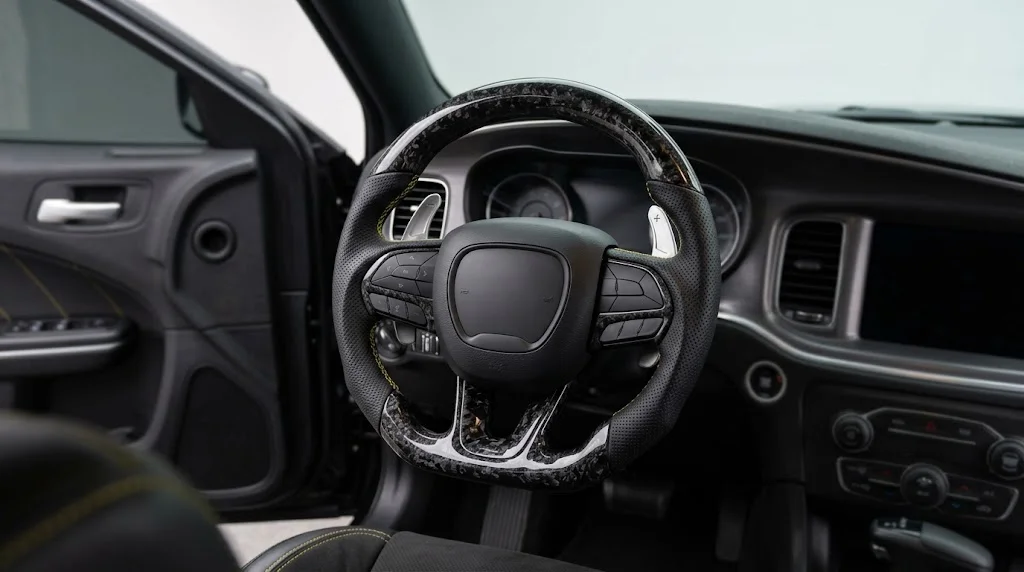
Factory paddles are moulded plastic on a plastic hinge. They work for years, and they feel vague from the first day.
Alloy is the popular choice on these cars, and the reason is sound. A heavier paddle carries more momentum into the switch, so the click lands at the end of the travel instead of somewhere in the middle.
Drivers sit differently, so the same paddle suits one owner and frustrates the next. A tall driver with the seat well back needs a longer paddle than a shorter driver who sits close to the wheel.
Think about where your hands actually sit. Nine and three is where most hands sit, and the factory paddle sits below and behind that grip. An extended paddle closes the gap without moving the hand.
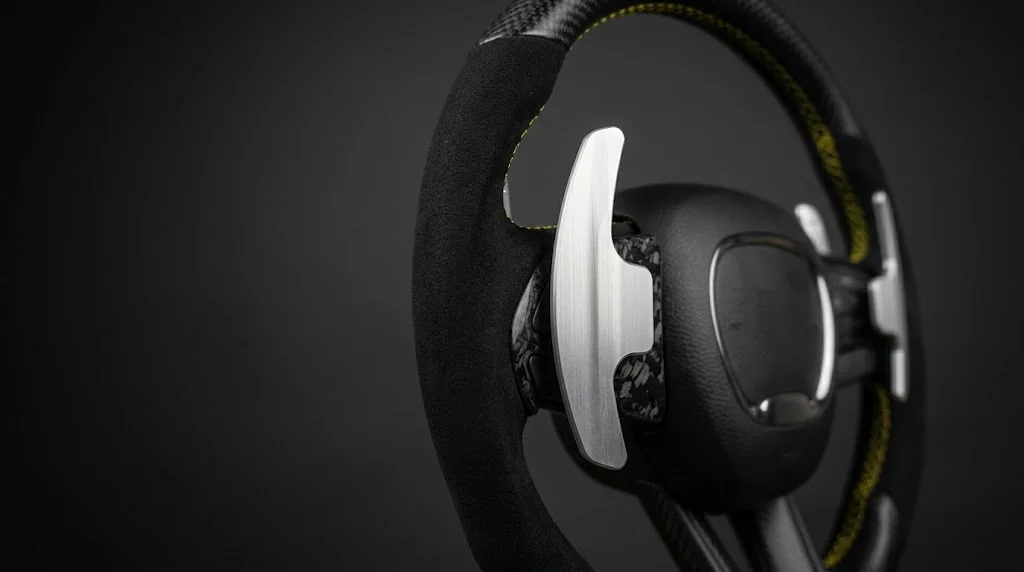
Track drivers tend to want the shortest travel and the firmest click. Street drivers usually prefer a paddle that does not catch a sleeve on the way past.
For that reason we quote a Dodge paddle shifter upgrade against the seating position as well as the car. A pair of owners with the same Charger can end up with different paddles.
The paddle bolts to a mount on the rear of the wheel frame, and that mount changes between generations. A paddle from a different year will bolt on and sit at the wrong angle.
One photograph settles it, and no number has to be taken. A shot of the rear of the wheel with the airbag out shows the mount, the screw pattern and the shape of the connector.
Send that picture before you order. It costs a minute and it prevents the most common return we see on these cars.
Adding paddles to a car built without them is a different project. The paddle is a switch, and a switch with nothing behind it does nothing.
The gearbox control unit has to support manual mode, and the column needs the right connector. Both are worth checking before any money is spent, because a car that cannot accept the signal will not accept the paddle either.
A Dodge that left the factory with a dial rather than paddles usually falls into this group. We say so early rather than after the wheel has been built.
A dark interior parked in the sun gets hot, and a metal paddle holds that heat longer than plastic. Owners in the south notice it in July and stop noticing by September.
Fit and finish both soften that. A paddle finished to match the interior stays cooler to the touch than a bare polished one. An Alcantara covered rim keeps the hands drier in the same conditions.
Cold is the other end of the same story. Alloy feels colder than plastic on a winter morning, which some drivers like and others do not.
Four details decide whether a paddle will fit. Start with the model, year and trim, then add the two photographs.
Add the VIN, because it narrows the option list to what the factory built. Where the rim is heated, add a photograph of the mat as well. The mat sits where the mount needs clearance.
Reusing the original module, the loom and the vehicle specific parts is the case where no further coding may be needed. The paddle changes and the electronics carry on as before.
A car that gains a function it never had is the other case. The control unit may then need to learn what is present, and a workshop visit becomes likely. Treat coding as a possible step and let the VIN decide.
Three issues come back to us most often. A paddle from another model year carries a different mount. A heated rim packs its matting where the paddle needs clearance. A manual car has no manual mode to command.
The fourth is the button pod. A wheel from another trim can share the badge and carry a different pod. The result shows up as dead buttons once everything is bolted back together.
None of these is a reason to avoid a Dodge paddle shifter upgrade. Each is a reason to send photographs before the order rather than after.
An airbag sits at the centre of this work, so hand it to someone qualified. Disconnect the battery and let the car power down before any fastener is loosened, and follow the Dodge procedure for your chassis.
Set the module down on something soft, away from the work area. Tighten the centre fastener to the figure in the workshop manual for your car, and treat that manual as the only source for it.
Ask for a photograph of the rear of the wheel before the airbag goes back in. The picture is the only record of the mount, and it saves work when a second paddle is ordered later.
Warranty questions follow any change of this kind. An aftermarket steering wheel does not automatically void a vehicle warranty under U.S. federal warranty law, but warranty coverage can still depend on whether the modification caused the specific failure being claimed.
Switch the car on, select drive and pull the left paddle. The gearbox should drop a ratio, and the cluster should show the change.
Repeat with the right paddle, then try both in manual mode. A paddle that clicks but does nothing is usually a connector that is not fully seated.
Turn the wheel to full lock and test again. The loom takes a different path there. A paddle that works straight ahead and fails at a quarter turn is telling you about the wiring rather than the switch.
No. It varies by year and trim, which is why the photographs come before the quote.
No. There is no manual mode in the gearbox for a paddle to command.
It feels colder than plastic on a frosty morning. The feeling fades within a week for most owners, and a finished surface is milder than bare polish.
Only for a re-trim. A new core leaves your factory wheel with you, and the paddles can be fitted before the wheel ships.
Yes. The finish can follow the stitch colour or the exterior paint. This choice belongs to the same Dodge paddle shifter upgrade conversation as the rim.
They will. The frame and the loom are reused, so the horn and the spoke buttons behave as they did before.
Ten to fifteen working days in production, then fifteen to twenty days in transit. The full window is twenty-five to thirty-five days.
Our Guangzhou workshop builds after the order lands, not before it. There is no rack of finished wheels waiting for a buyer, and no pattern cut until your chassis has been checked.
Thirteen or more years of design, engineering and production sit behind the frames we hold, from Challenger mounts to Durango button pods. Paddle shape, rim covering and stitch colour stay your call, and each is matched to your VIN before work starts.
Every order ships tracked worldwide, carries a three-year warranty, and can come back within thirty days on an RMA request. The person who reads your photographs is the person who checks the pattern.
Four pages on this site take the same car further. The Hellcat and SRT wheel guide covers the frames those cars use. The installation and airbag guide walks through the battery and module steps. The gloss and matte comparison deals with the finish question if a new rim is also on the list.
For the catalogue, the shop holds every build. The Dodge pages are the brand listing, the Challenger page, the Charger page and the Durango page.
Begin with the year, the trim and the gearbox, then add the two pictures. A reply with a confirmed mount and a build date follows before any work begins on your Dodge paddle shifter upgrade.
Two builds in the catalogue suit these cars. The matte carbon wheel listed for the SRT Charger and Durango is the quieter of the two. The forged carbon wheel for the Charger and Challenger SRT carries a bolder pattern. Both can be ordered with the paddle mount your car uses.
Further reading sits in the installation guide, the FAQ and the about page. Fitment and delivery questions can go to the contact page or the inquiry form. The shipping policy sets out the transit window, and the return policy covers a change of mind. The federal warranty position is written into 15 U.S.C. 2304, and the related interpretations sit in 16 CFR Part 700.
How to clean carbon fiber and Alcantara on a Dodge steering wheel: a ten minute routine, the cloths to use, and the products that damage both surfaces.
Read More →How to fit a Dodge steering wheel safely: isolating the battery, handling the airbag module, marking the spline, and the checks that follow the swap and the details that follow.
Read More →How gloss and matte carbon behave on a Dodge steering wheel: which finish suits a Challenger, Charger or Durango, and how each one ages in the sun.
Read More →