
The Dodge Paddle Shifter Upgrade Explained
What a paddle swap changes on an automatic Challenger, Charger or Durango, how the mount behind the rim decides the fit, and what to test before the drive home.
Read More →Guide · 10/5/2026
Flat bottom or round for your Dodge? How each shape affects knee room, steering feel and appearance, and how to choose between them before you order.
Dodge cabins are generous with space, and that changes the answer to the shape question. A round rim suits a big car with a relaxed driving position, while a squared-off lower section buys clearance under the wheel and looks purposeful. The Dodge flat bottom steering wheel question is really about how you sit and how you use the car. This guide compares the two shapes directly.
A squared-off lower section helps when you need legroom under the rim. A round rim helps when you want the wheel to feel identical at every steering angle. Everything else is appearance.
| Attribute | Flat bottom | Round |
|---|---|---|
| Knee clearance | More, especially on a lowered seat | Standard |
| Feel at large angles | Noticeably different near the bottom | Consistent all the way round |
| Getting in and out | Slightly easier in a tight cabin | Unchanged |
| Appearance | Purposeful, motorsport influenced | Classic, understated |
| Instrument view | Clearer on a lowered seat | Depends on seating position |
The flat section sits at six o'clock, where hands rarely rest during normal driving. This is why a Dodge flat bottom steering wheel can free knee room without hurting grip. You notice the difference most when you slide into the car or when you are sitting low with the seat pushed back.
The rim itself also becomes easier to read at a glance. With a flat edge at the bottom, the wheel angle is obvious without looking for a badge. Drivers who use the car for long motorway runs find that helpful at night. Anyone who tows or carries passengers in the back should also think about how often the wheel reaches full lock. Parking a Charger involves a lot of low-speed steering, and the flat edge is noticeable there.
A round rim keeps the geometry identical through every input, which suits a heavy car with rear-wheel drive. Nothing changes as your hands travel around the rim, and nothing catches you out during a quick correction. Drivers covering long distances often prefer that consistency.
There is one more consideration. A round rim is easier to match to an existing airbag cover on older LX cars, simply because more of them were built that way. That can shorten a build by a week or more. There is also a practical argument for older cars. A round rim matches the original factory look, so the wheel never draws attention from the rest of a tidy interior. If originality matters, round is the safer pick.
The shape does not change grip. Grip comes from the material at nine and three, which is leather or Alcantara on either design. What changes is where your hands sit relative to the rim, and how much space your legs have underneath it.
For a tall driver in a Challenger, a flat lower section can be the difference between a comfortable seating position and a compromised one. For a shorter driver, the round rim usually feels more natural because the reach is shorter anyway. If two people share the car, agree on the shape before ordering. Changing your mind later means a second build and a second wait, because the rim is cut to the shape you specified.
These cars were sold with both shapes depending on trim and year. Buyers of a used car often do not know which the factory fitted, and they want the replacement to match or deliberately differ. Either choice is defensible, and neither one is a modification that changes how the car drives. Two patterns show up in our orders. Taller drivers choose flat bottom almost every time, because the extra space under the rim matters on a long journey. Shorter drivers more often stay with round, because the reach suits them and the classic outline matches the car. Whichever way you go, a Dodge flat bottom steering wheel is a cosmetic decision rather than a mechanical one.
The outline is a preference, but the frame is not. We need the chassis number and the full options list. Add a daylight photograph of the wheel face, and one of the rear with the airbag out. Any Dodge flat bottom steering wheel order is confirmed against those details before cutting begins.
That set reveals the spoke profile, the button cluster and the plug type. Challenger and Charger trims differ, so the trim code matters alongside the year. We build nothing until the match is confirmed, and we will ask for a clearer photograph rather than guess.
A new shape should not disable a working switch. Our builds reuse the frame and harness already fitted to your Dodge.
| Function | Typical outcome |
|---|---|
| Airbag | Original module normally reused; cover built to suit it |
| Multifunction buttons | Retained when the original button frame is reused |
| Paddle shifters | Retained on automatic cars; manual cars have no paddles |
| Heated rim | Depends on the heating element and trim; confirm first |
| Uconnect voice buttons | Retained where the original frame carries them |
Gearbox decides whether paddles come into it. Plenty of these cars left the factory with a manual, and those builds have nothing to retain.
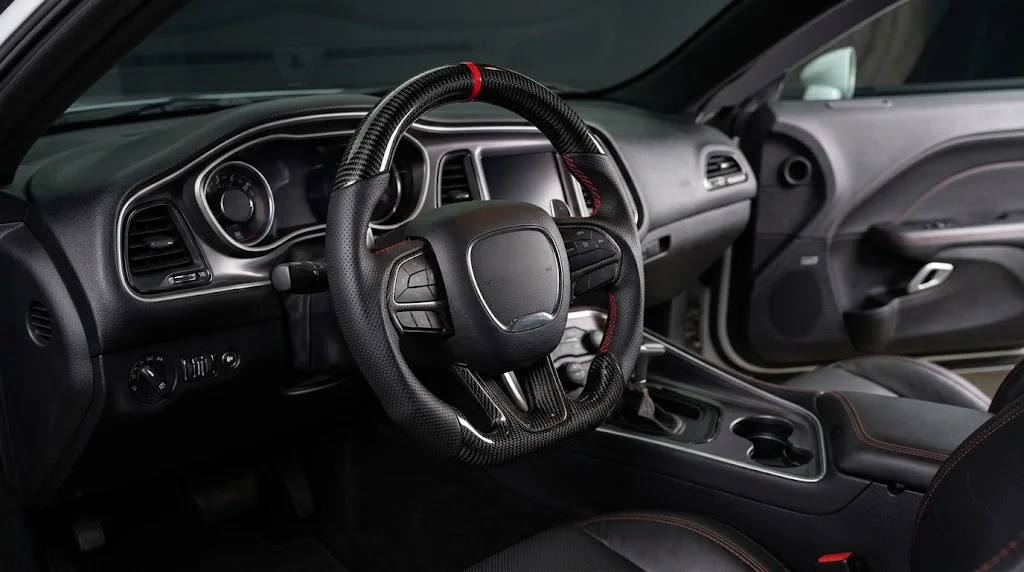
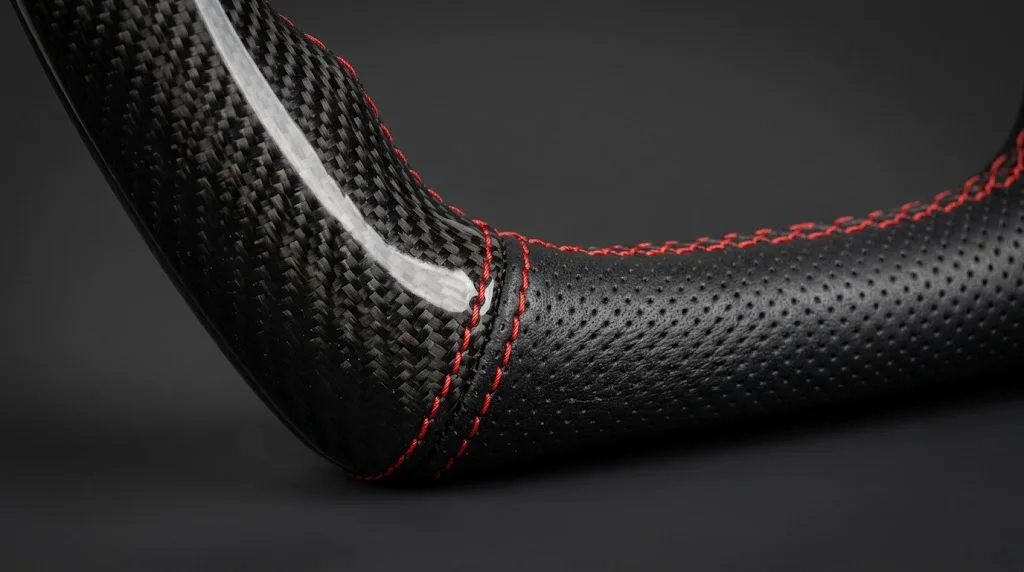
The shape should sit comfortably with the rest of the cabin. A flat bottom paired with gloss twill carbon and red stitching looks deliberate in an SRT interior. A round rim with a simpler leather finish suits a car kept closer to standard. The right Dodge flat bottom steering wheel for a given cabin depends on how the rest of the trim is finished. Mixing a motorsport shape with a conservative trim can look like two different decisions were made.
Both shapes are fitted the same way, and an airbag sits in the middle of the job. Give the work to someone qualified. Isolate the battery and let the car power down fully before loosening fasteners. Follow Dodge procedure for your chassis rather than a general guide found online. Place the module on something soft, and set the centre fastener to the figure in the workshop manual. No other source should be used for it.
Afterwards, drive a short distance and check that the rim is centred. Work through the buttons, any paddles and the horn. A warning lamp that stays on means the car needs a scan before further driving.
Warranty questions follow any modification. An aftermarket steering wheel does not automatically void a vehicle warranty under U.S. federal warranty law, but warranty coverage can still depend on whether the modification caused the specific failure being claimed.
Coding is unrelated to shape. Where the original module, the harness and the vehicle-specific parts are reused, further coding may not be required. A module from another generation is a different case, and the control unit may then need to learn what is present.
Because that varies between cars, we treat coding as a possible step rather than a certainty. Send the chassis number with images of both electronic units and we will say whether a workshop visit looks likely.
Problems on these cars come from fitment, not from the shape. A wheel taken from a different trim or year often shares the badge but not the button frame. A heated rim on a car that never had one leaves a spare plug and a switch doing nothing. Paddle hardware differs between automatic and manual cars, so the wrong set leaves paddles that do nothing. A cover shaped for a Hellcat airbag arriving on a standard car is the quiet cosmetic failure. One more point is worth checking before you order. The wheel diameter is the same for both shapes, so the airbag cover and the button frame transfer in either direction without new parts. The four checks above clear every case.
No. It changes where your hands meet the rim and how much knee room you have. The steering itself is unaffected.
Both, depending on trim and year. Give us the chassis number and we will tell you what your car left the factory with.
The module is the same. The cover is shaped to suit the rim, which is why we ask for a photograph of both.
Yes. The frame and electronics are unchanged, so the change is cosmetic and reversible.
Only for a donor build. A newly made core leaves your factory wheel with you.
Ten to fifteen working days in production, then fifteen to twenty days for shipping. Expect twenty-five to thirty-five days overall.
Rims are cut, stitched and assembled in our own Guangzhou workshop. Thirteen or more years of design and production experience sit behind the catalogue patterns, and nothing begins before an order arrives. Shape, material and stitch are your decisions; each one is checked against your chassis before cutting starts. Every order ships tracked worldwide with a three-year warranty and thirty days for returns via an RMA request.
Our Challenger and Charger SRT guide covers the trims in more depth and explains how the frames differ. Most of what is compared here appears there too. The full range sits in the shop, and the Dodge pages are Dodge fitment and the Challenger listing.
Tell us which shape you are leaning towards, add the chassis number and the options list, and send a photograph of the wheel. We will reply with a confirmed build and a date before we make your Dodge flat bottom steering wheel. Three catalogue entries suit these cars. The first is the forged carbon wheel for the Charger and Challenger SRT. The second is the gloss carbon wheel for the Challenger. The third is the matte carbon wheel for the SRT range.
More reading is there if you would like it. The installation guide covers the battery and airbag sequence, and the
What a paddle swap changes on an automatic Challenger, Charger or Durango, how the mount behind the rim decides the fit, and what to test before the drive home.
Read More →How to clean carbon fiber and Alcantara on a Dodge steering wheel: a ten minute routine, the cloths to use, and the products that damage both surfaces.
Read More →How to fit a Dodge steering wheel safely: isolating the battery, handling the airbag module, marking the spline, and the checks that follow the swap and the details that follow.
Read More →