The Dodge Paddle Shifter Upgrade Explained
What a paddle swap changes on an automatic Challenger, Charger or Durango, how the mount behind the rim decides the fit, and what to test before the drive home.
Read More →Guide · 9/28/2026
A model-by-model guide to the Dodge steering wheel upgrade: Challenger and Charger fitment checks, airbag and paddle retention, donor cores and coding conditions.
A Challenger and a Charger ask for the same thing from the wheel. A thick rim, a flat bottom and a stitch line that matches the interior.
Both cars also share one problem. The leather goes glossy at 9 and 3, and the red stitching fades long before the rest of the cabin. A Dodge steering wheel upgrade is a fitment project first, and a styling project second.
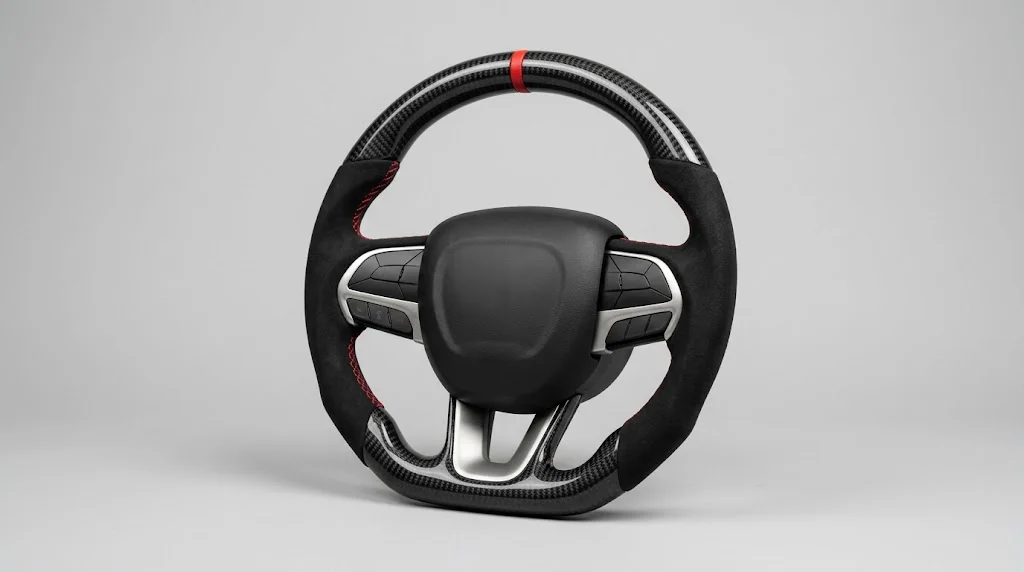
Studio view of a RYDEMARK custom steering wheel. Black twill carbon fiber on the rim, black Alcantara grips and a bright red twelve o'clock stripe. Brushed metal spoke accents, on a plain light grey backdrop.
Each Dodge platform has its own airbag type, plug and button set. Treat these notes as a starting point, then verify against your own car. Current builds are listed on the Challenger fitment page and the Charger fitment page.
The Challenger uses a thick rim with a flat bottom on SRT and Scat Pack cars. The automatic carries paddle shifters, while the manual has none. Heated rims were fitted to some trims and markets.
The Charger shares the cabin theme but uses its own button pods. The eight-speed automatic carries paddles, and the SRT trims add their own switchgear.
Two Dodges of the same year can carry different wheels. Platform, trim, market and the option list all change the hardware, so start from your VIN and photos of the wheel you have now.
Wear shows up first on a daily-driven car. The leather goes glossy at 9 and 3 o'clock, and the thumb rests flatten into the rim.
A custom rim also changes how the car feels. A thicker section sits better in the hand, and Alcantara keeps its grip on a hot day.
Three build directions cover most orders. A Challenger wheel and a Charger wheel start from the same core family, so only the skin and the rim shape change.
Continuous-weave carbon fiber is laid by hand and cured under heat and vacuum. Twill shows the diagonal pattern, while forged carbon compresses chopped fiber in a mold for the marbled look.
Alcantara has a dry, high-friction surface that suits a muscle car. It needs brushing and periodic cleaning, and many drivers pair it with carbon on the spokes.
Leather keeps a Challenger or Charger cabin close to factory. Perforated leather adds dimples, breathes better and hides wear around the 9 and 3 positions.
| Build | Look | Grip in summer | Long-term care |
|---|---|---|---|
| Twill carbon fiber | Diagonal weave, satin or gloss | Warm to the hand | Wipe with a soft cloth |
| Forged carbon | Marbled, matte-leaning | Warm to the hand | Same as twill, no polish |
| Alcantara | Matte, suede-like | Stays dry and planted | Brush and clean periodically |
| Perforated leather | Dimpled, factory look | Breathes well | Condition twice a year |
Fitment is not decided by the model name alone. The platform, the model year, the trim and the original modules all matter. An SRT airbag and a standard one do not share every part.
For that reason, every Dodge steering wheel order starts with verification. We also check airbag compatibility from the module type, the airbag shape and the connector. Have these details ready before you order:
With those details we confirm the core, the airbag type and the functions to keep. Send your VIN and photos through our inquiry form or the contact page before you order.
A custom build keeps the parts that already work. The restraint module, the button pods and the factory wiring channels stay in the car wherever they were specified.
| Function | Typical approach | What we verify |
|---|---|---|
| Airbag (restraint module) | Original factory module reused, non-invasive pin-to-pin alignment | Airbag type and connector |
| Button pods | Original pods reused in their original positions | Pod layout and connector |
| Paddle shifters | Factory module retained on automatic cars | Transmission and paddle type |
| Heated rim | Original element and circuit retained where factory-fitted | Heating option and connector |
| LaneSense input | Column and sensor side left untouched | Driver assistance package |
| Cruise and audio keys | Original switchgear transferred | Trim-specific key count |
A rim cannot add a function the car was not built with. A manual Challenger has no paddles to keep, and a car without factory heating cannot gain it from a rim.
An OEM replacement core and a generic aftermarket frame can look alike. Three details separate them: the spline interface, the module mounting points and the core material.
We build on an original OEM donor core for your chassis. Its spline interface is designed to preserve factory steering-column engagement when the correct core and service procedures are used.
A generic frame may not carry the same mounting bosses, thread inserts or column seating.
Load path through the column
----------------------------
  rim load --> spoke root --> center hub --> spline --> steering column
                                     |
                                     +--> restraint module (fixed position)
|
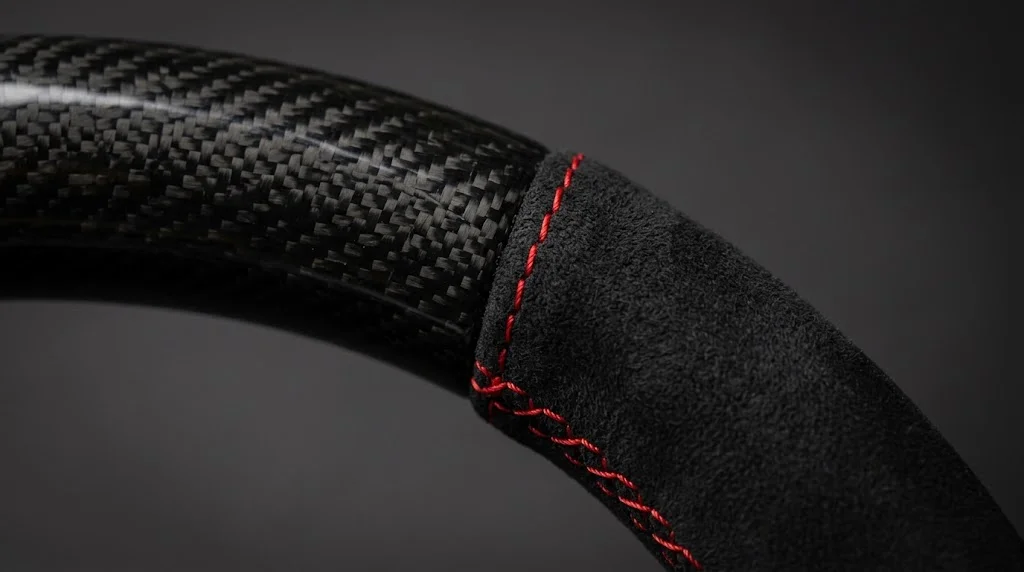
Macro studio view of black twill carbon fiber weave meeting black Alcantara with bold red contrast stitching on a RYDEMARK custom Dodge steering wheel rim.
Material changes grip, care and appearance, not how the core mounts. A carbon fiber wheel can use leather grips, Alcantara or a mix. All of them can be built on the same core for either car.
A flat-bottom rim is the Charger and Challenger signature, and it adds leg room on a low seat. A round rim keeps the standard silhouette.
Both shapes can be built on the same donor core, and the restraint module stays in its original position and angle.
Steering-column work sits inside the Supplemental Restraint System (SRS). The restraint module has a fixed position and angle relative to the driver.
Battery isolation, careful handling and the fastening sequence from the manufacturer's workshop manual (Mopar TechAuthority and wiTECH) all matter. A certified automotive technician should carry out the fitting, following authorized workshop manual procedures. We do not quote torque figures, because they differ by chassis and fastener.
After fitting, check the horn, the buttons, the paddles, the heating and the instrument cluster. Report any existing warning light before the build, not after. Our installation guide covers the general sequence.
Coding is the question buyers ask most, and the honest answer is conditional. When the original steering wheel module, the wiring connectors and the vehicle-specific parts are reused, additional coding may not be required. Compatibility should still be confirmed against your car's configuration before installation.
A different module family, or a part the car expects but does not have, may call for a diagnostic session. A qualified technician carries that out with the manufacturer's diagnostic tooling. We will tell you before you order.
Signal flow after the swap
--------------------------
  clock spring --> factory harness --> column module --> CAN / LIN bus
       ^                                                     |
       |                                                     v
  buttons / paddles / heating --- same factory channels --- cluster
|
These issues come up most often when a wheel is ordered without verification.
On most builds the original factory restraint module is reused, with non-invasive pin-to-pin alignment. SRT and standard trims take different covers, so send a photo of your airbag and its connector.
No. A manual car has no paddles on the wheel. Automatic Challengers and Chargers keep their factory paddle module.
If your original rim is heated, the element and its circuit are retained. A car that left the factory without heating cannot gain it from a new rim.
Yes, in most cases. The composite skin sits on the donor core, and the original modules and connectors are reused.
Yes. Flat-bottom and round rims are both built to order for the Charger. The restraint module keeps its original position and angle.
In most cases we supply an original OEM donor core for your chassis. If you would rather send your own core, contact us first so we can check it.
Start with your VIN and clear photos of your current wheel, front and back. Add your model year, market, trim and the options to keep. We confirm the core and the airbag type before production begins.
RYDEMARK is the brand of Guangzhou Yingjie Technology Co., Ltd. We design and build custom steering wheels in our own factory in Guangzhou, China. Read more on our About page.
A Dodge steering wheel is built to order, so price depends on the core, the materials and the options. We confirm the quote before production. Returns follow our published returns policy, and lead times are listed in the shipping policy.
An aftermarket steering wheel does not automatically void a vehicle warranty under U.S. federal warranty law, but warranty coverage can still depend on whether the modification caused the specific failure being claimed.
🔗 Topic: All Dodge fitments — Challenger, Charger, Durango, Viper and the classics, grouped by platform.
🔗 Topic: Dodge Challenger fitment page — the builds we handle for the Challenger range.
🔗 Topic: Dodge Charger fitment page — Charger builds in carbon, Alcantara and leather.
🔗 Topic: Dodge Full Series Real Carbon Fiber Steering Wheel — the carbon build across the Dodge range.
🔗 Topic: Dodge SRT Forged Carbon Steering Wheel with Alcantara Airbag Cover — the forged carbon SRT build.
🔗 Topic: RYDEMARK FAQ — ordering, payment, shipping and warranty questions in one place.
Send your VIN and photos of your current wheel. We confirm the core, the airbag type, the functions to retain and the material options before production starts. For a Dodge steering wheel replacement or a retrofit, that check comes first.
Next steps: Dodge Challenger wheels · all RYDEMARK wheels · request a custom build · contact us.
Further reading: Magnuson-Moss Warranty Act (15 U.S.C. §2304) · NHTSA — Air Bags.
What a paddle swap changes on an automatic Challenger, Charger or Durango, how the mount behind the rim decides the fit, and what to test before the drive home.
Read More →How to clean carbon fiber and Alcantara on a Dodge steering wheel: a ten minute routine, the cloths to use, and the products that damage both surfaces.
Read More →How to fit a Dodge steering wheel safely: isolating the battery, handling the airbag module, marking the spline, and the checks that follow the swap and the details that follow.
Read More →